
Nmfc Calculator
Enter the dimensions and weight of each pallet or piece in your LTL shipment. The calculator works out cubic feet and density in pounds per cubic foot, and estimates the density-based freight class carriers use to price less-than-truckload freight.
- Free to use
- No sign-up
- Runs in your browser
Calculate density and freight class
| Pieces | Length | Width | Height | Weight each |
|---|
LTL Shipping Density Workbook
Plan multi-pallet shipments, compare packing options by density and class, and keep a printable bill-of-lading checklist.
- Multi-line density & class workbook (XLSX, PDF)
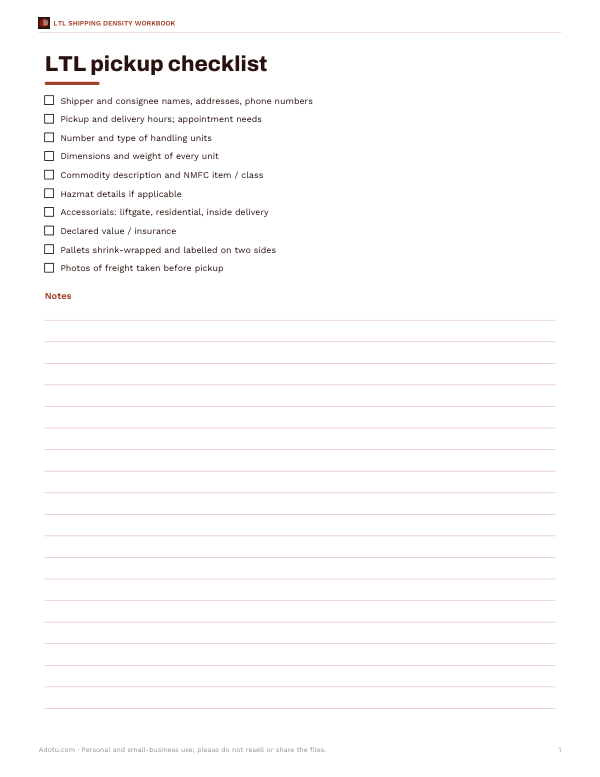
- BOL & pickup checklist (PDF, DOCX)
Formats: XLSX, PDF, DOCX. Instant download after payment (link valid 72 hours, up to 5 downloads). AI-assisted: the templates were drafted with AI help and reviewed and laid out before publishing.
$5.00 USD, one-time
- Instant download
- 7-day refund
- Secure checkout by Stripe
7-day money-back guarantee. Full refund within 7 days of purchase, even after you download.
Full refund within 7 days — see the refund policy and license.
Free printables
Single sheets you can print right now, no sign-up. The full pack adds every sheet in one download plus the editable files.
What NMFC freight class is
The National Motor Freight Classification (NMFC) is a standard maintained by the National Motor Freight Traffic Association (NMFTA) that groups commodities moving by less-than-truckload (LTL) carriers in the United States into 18 classes, from class 50 to class 500. The class, together with weight, distance and any accessorial services, determines the rate. Lower classes are dense, durable, easy-to-handle freight that is cheaper per pound to ship; higher classes are light, bulky, fragile or valuable freight that takes up more trailer space relative to its weight.
Four characteristics define classes: density, stowability, handling and liability. For many commodities density is the deciding factor, which is why a density calculation is the first step in estimating class.
How to calculate freight density
- Measure the length, width and height of each piece in inches, including the pallet and any overhang. Measure at the widest points.
- Multiply length × width × height to get cubic inches, then divide by 1,728 to get cubic feet.
- Multiply by the number of identical pieces.
- Add the weights of all pieces, including pallets and packaging.
- Density = total weight ÷ total cubic feet, in pounds per cubic foot (pcf).
Carriers measure the space your freight occupies, so round each dimension up to the next whole inch and include anything that stops another pallet being stacked on top. If your freight cannot be stacked, some carriers charge as if the full trailer height above it were used.
Density guideline used for estimates
This widely used density-to-class guideline gives a first estimate for freight that is classed by density:
| Density (lb/ft³) | Class | Density (lb/ft³) | Class |
|---|---|---|---|
| 50 or more | 50 | 9–10.5 | 100 |
| 35–50 | 55 | 8–9 | 110 |
| 30–35 | 60 | 7–8 | 125 |
| 22.5–30 | 65 | 6–7 | 150 |
| 15–22.5 | 70 | 5–6 | 175 |
| 13.5–15 | 77.5 | 4–5 | 200 |
| 12–13.5 | 85 | 3–4 | 250 |
| 10.5–12 | 92.5 | 2–3 | 300 |
| — | — | 1–2 | 400 |
| — | — | Less than 1 | 500 |
The official NMFC assigns classes item by item, and the tariff is revised through periodic dockets that have moved many commodities to density-based classification. The authoritative class for your product comes from its NMFC item number; carriers and the NMFTA's ClassIT service can confirm it.
Worked example
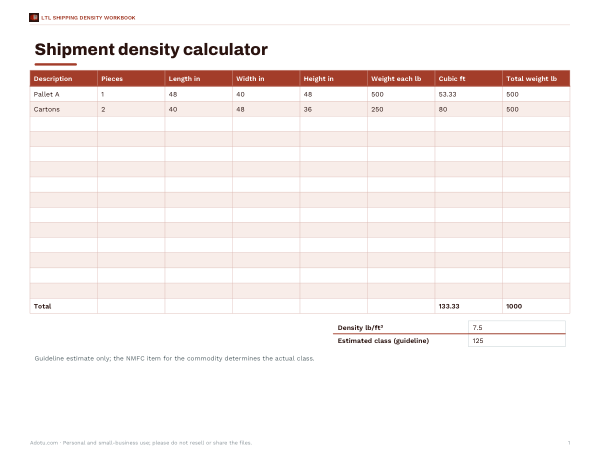
A shipment has one pallet 48 × 40 × 48 inches weighing 500 lb and two cartons 40 × 48 × 36 inches weighing 250 lb each. The pallet is 92,160 cubic inches, or 53.3 cubic feet; each carton is 40 cubic feet, so the total is 133.3 cubic feet. Total weight is 1,000 lb, giving a density of 7.5 lb per cubic foot. On the guideline above that falls between 7 and 8, estimating class 125. Reducing the pallet height by consolidating cartons would raise density and could lower the class.
Why getting the class right matters
Carriers inspect and re-weigh freight, often with dimensioning systems on the dock. If the class or weight on your bill of lading is wrong, the carrier issues a reclassification or re-weigh, and you pay the higher rate plus a possible inspection fee. Misclassifying freight to get a lower rate is not only costly when caught; it also invalidates quotes and can affect liability limits in a damage claim. Measuring carefully and using the correct NMFC item number avoids these surprises.
Tips to reduce LTL shipping cost
- Use the smallest pallet that safely fits the product and avoid overhang.
- Stack cartons squarely and shrink-wrap them so the pallet is stable and stackable.
- Increase density by consolidating shipments into fewer, fuller pallets.
- Request quotes with accurate dimensions and weight, not just weight.
- Avoid unnecessary accessorials such as residential delivery or liftgate if the consignee has a dock.
- Ask whether the carrier offers volume or density-based pricing for your lane.
Metric shipments
If you measure in centimetres and kilograms, the calculator converts to inches and pounds before applying the guideline, because US LTL classes are defined in pounds per cubic foot. One cubic metre is 35.31 cubic feet and one kilogram per cubic metre is 0.0624 pounds per cubic foot. Outside the US, LTL pricing more often uses volumetric weight — for example, a chargeable weight based on a cubic-metre factor — rather than NMFC classes.
Information to have ready when booking
Carriers quote faster and more accurately when you supply everything up front: pickup and delivery ZIP codes, the number and type of handling units (pallets, crates, cartons), dimensions and weight of each unit, the NMFC item number and class, whether the freight is stackable, and any accessorial services such as liftgate, inside delivery, appointment or limited-access locations like schools and construction sites. Hazardous materials need their UN number, packing group and emergency contact on the bill of lading.
Frequently asked questions
How do I calculate cubic feet of a pallet?
Multiply length × width × height in inches and divide by 1,728.
What freight class is 10 pounds per cubic foot?
On the common density guideline, 9–10.5 pcf is class 100. Confirm with the NMFC item for your commodity.
Is density the only factor in freight class?
No. Stowability, handling and liability also count, and some items have fixed classes regardless of density.
Should I include the pallet weight?
Yes. Density uses the gross weight and dimensions of the shipment as tendered, pallet included.
Where do I find the NMFC item number?
Through the NMFTA's ClassIT subscription service, your carrier or a freight broker.
What is a reweigh or reclass fee?
When a carrier's dock measurements show a different weight, size or class from the bill of lading, it re-rates the shipment and may add an inspection charge.